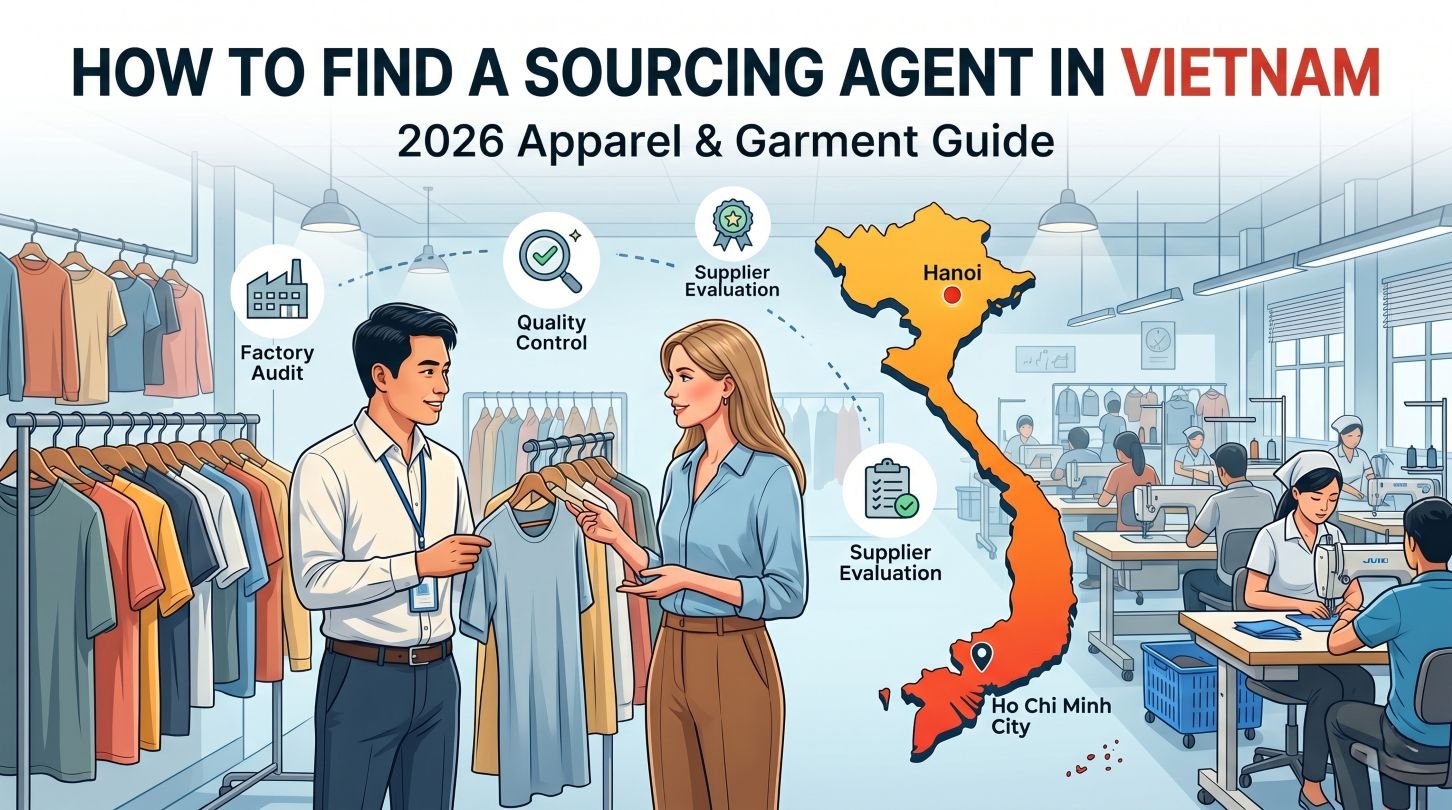
Vietnam overtook China as the U.S.’s #1 apparel supplier in October 2025. Picking the wrong sourcing agent will cost you that advantage.
Why apparel buyers need a Vietnam sourcing agent in 2026
Vietnam shipped roughly $44 billion in textiles and garments in 2024 and is on track for $48–50 billion in 2025, ranking second globally behind China. The U.S. now absorbs 38% of those exports, up from 36.3% a year earlier. (Sources: General Department of Customs of Vietnam; VITAS, May 2025.)
The country runs over 13,000 textile and apparel enterprises with around 2.5 million workers. Adidas alone uses 167 Vietnamese factories. Nike, H&M, Gap, Lululemon and Uniqlo all source from the same network.
That density is your problem. Tier-one factories are fully booked by Walmart and Costco. The mid-tier ones that take 1,000-piece MOQs (Minimum Order Quantities) rarely have English-speaking merchandisers. A sourcing agent on the ground closes that gap.
Three pressures make 2026 hard:
- The U.S. IEEPA (International Emergency Economic Powers Act) reciprocal tariff pushed average U.S. apparel duty from 14.7% in January 2025 to 26.4% in July 2025, the highest in decades
- The UFLPA (Uyghur Forced Labor Prevention Act) requires documented proof that no cotton in your garment touched Xinjiang
- The EU CSRD (Corporate Sustainability Reporting Directive) and EU Strategy for Sustainable and Circular Textiles push BSCI, GOTS and GRS audits onto suppliers
A serious agent already runs paperwork for OEKO-TEX (chemical), BSCI (social compliance), WRAP (responsible production), GRS (recycled content) and CPSIA (US kidswear). Without one, your shipment can be detained at port.
The 5 channels to find an sourcing agent in vietnam
| Channel | Avg. quality | Hidden cost risk | Best for |
| Alibaba “verified” suppliers | Mixed | High (commissions buried in unit price) | Basic categories, low-MOQ trials |
| Freelancers (Upwork, Fiverr) | Variable | Medium | Single-product orders under $5K |
| Independent local agents (HCMC or Hanoi) | Good if vetted | Low if contract is clear | Custom collections, repeat orders |
| Established sourcing agencies | High | Low | Multi-SKU programs, technical sportswear, kidswear |
| Trade-show contacts | High | Low | Buyers who can travel once a year |
Trade shows deserve a callout. SaigonTex–SaigonFabric (HCMC, April), HanoiTex–HanoiFabric (Hanoi, October) and the VTG Vietnam Textile & Garment Expo are where most serious garment agents physically work. Walking those halls for two days teaches you more than a month on Alibaba.
7 questions to ask before you sign
These seven separate professionals from order-takers:
- Which factories will you visit for me, and can I have the audit checklist you use?
- How are your fees structured, and do you also take commission from the factory side? (If yes, walk away.)
- Show me three references from apparel brands who shipped this year, by category (knitwear, woven, performance).
- Who handles UFLPA cotton-origin documentation and OEKO-TEX or BSCI compliance verification?
- What is your defect-rate tracking system, and your average AQL (Acceptable Quality Limit) on garment finishing?
- Do you run mid-production audits at 30% and 70%, or only pre-shipment?
- Will I get a copy of the original FOB (Free On Board) factory invoice, or only your repackaged quote?
Question 7 matters most. An agent who refuses to share the raw factory price is hiding margin. That is the single biggest red flag in textile sourcing in Vietnam.
What you will actually pay
Five pricing models dominate. Realistic ranges for apparel below.
| Model | Typical range (apparel) | Best when |
| Commission on order value | 5%–10% | Recurring orders, $30K+ per shipment |
| Flat project fee | $1,000–$4,000 | One-off capsule collection |
| Monthly retainer | $1,500–$4,000/month | Active sourcing pipeline, multiple SKUs |
| Service fee on top of FOB | 3%–8% added | Buyers who want price transparency |
| Performance-based | Negotiated | Pure cost-reduction missions |
Commission below 4% on apparel is suspicious. Either the agent takes a kickback from the factory side, or they skip QC visits to protect margin. Above 10% is uncompetitive without a private testing lab.
Red flags that should kill the deal
- They quote you a price without naming the factory
- Their portfolio shows only finished garments, no factory floor or production line shots
- They cannot show a single VITAS (Vietnam Textile and Apparel Association) member factory in their network
- They refuse to disclose their cotton supply chain mapping for UFLPA compliance
- They insist on receiving sample payments in a personal account
- They refuse to let you visit the factory yourself
- They have never run a third-party audit (SGS, Intertek, Bureau Veritas) on a recommended supplier
Where apparel-specific agents actually cluster
For garment and clothing manufacturing, the talent is geographically split:
- Ho Chi Minh City + Bình Dương + Đồng Nai (south): largest garment cluster: sportswear, denim, casualwear, knitwear at scale. Nike and Adidas concentrate here. Primo Sourcing operates from HCMC with a verified network across this southern belt and runs mid-production audits at 30% and 70%
- Hanoi + Hưng Yên + Bắc Ninh + Thái Bình (north): knitwear, outerwear, technical uniforms; lower turnover, more stable lead times; access to Hai Phong port
- Đà Nẵng (central): emerging sportswear and lightweight outerwear hub
- Nam Định: heritage textile region; vertical mills running yarn → fabric → finished garment
Two filters that work:
- LinkedIn search: “sourcing agent” “Ho Chi Minh” apparel. Filter by 5+ years experience and a Western fashion brand visible in their content
- VITAS member directory (vitas.vn). Every member is registered and traceable in Vietnam’s textile industry
A serious agent will let you book a half-day factory tour before you commit to anything. If they refuse, the relationship is already broken.